Narusawa SETI
D'ou venons-nous? Que sommes-nous? Ou allons-nous?
Shin-ya Narusawa, Ph D. (Senior Researcher of Nishi-Harima Astronomical Observatory, University of Hyogo)
Recent paper:
Which Colors would Extraterrestrial Civilizations use to transmit Signals?:
The “Magic Wavelengths” for Optical SETI
Narusawa, S., Aota, T. & Kishimoto, R. 2018 New Astronomy 60, 61
IAA 2015
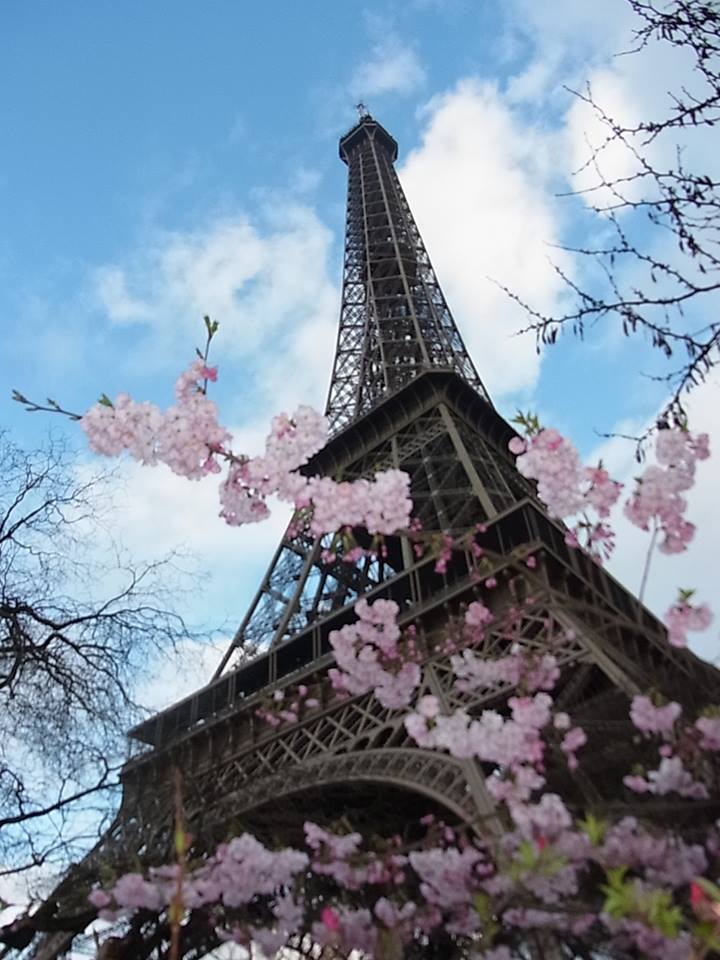
I attended the IAA 2015 (Paris) and lectured on the "Magic wavelengths"for OSETI.
64th IAC (2013)
We have presented about NAYUTA OSETI and Project Dorothy at the 64th IAC.
Narusawa (2013)
“Project Dorothy: World joint SETI observation to commemorate the 50th anniversary of project OZMA.”
(IAC-13.A4.1.2)
↑ A report about Project Dorothy is selected to Annual Rudolph Pesek Lecture
Narusawa (2013)
“NAYUTA OSETI: Optical SETI with the largest telescope in Japan.”
(IAC-13.A4.P.2)
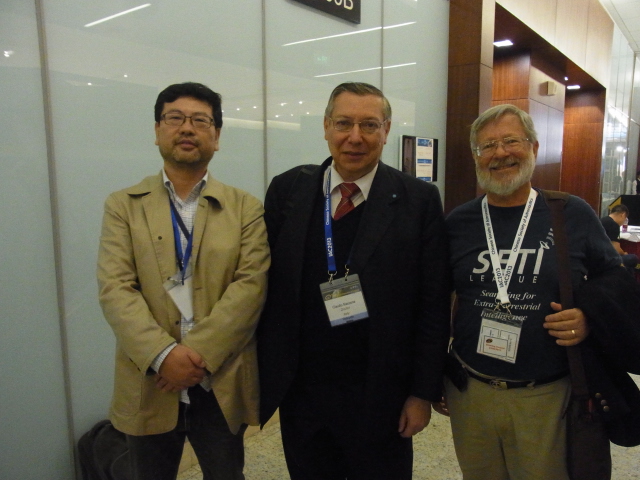
with Dr. Claudio Maccone (Chair of IAA SETI Permanent Committee, left) and Dr. SETI = H.Paul Shuch (Vice-Chair).
AbSciCon 2012
Narusawa, S. et al. (2012)
“Project Dorothy: Worldwide Joint SETI Observation to Commemorate the 50th Anniversary of Project OZMA
Societal Impact of Discovering Extraterrestrial Life Posters (#2437)”
Narusawa, S. & Sakamoto, M. (2012)
”OSETI with the general public and discussion on the IAA SEI protocol”
Societal Impact of Discovering Extraterrestrial Life Posters (#2436)
AbSciCon 2010
We reported the project SAZANKA at the Astrobiology Science Conference 2010 (Apr. 29, League City, Texas).
Narusawa, S. et al (2010)
“Project SAZANKA; The Multi-site and Multi-frequency Simultaneous SETI Observation in Japan” (#5074)
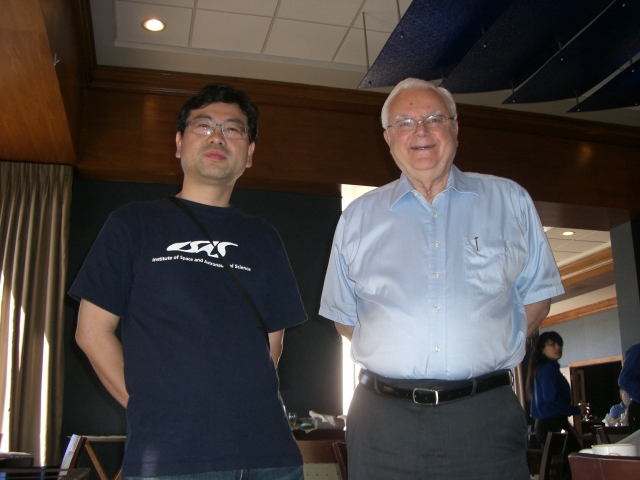
with Dr. Frank Drake (Apr. 29, 2010, Houston)

Project Dorothy (the 50th anniversary of project OZMA, Worldwide Joint SETI Observation)

Japanese first optical SETI observations with the largest telescope in Japan
(2005 - 2009)

The multisite and multifrequency Simultaneous SETI observation in Japan (Nov. 11 and 12. 2009).
We reported this project at the Astrobiology Science Conference (Apr. 2010, Houston)
SETI Workshop in Japan
Nov. 3 and 4, 2007 at Nishi-Harima Astronomical Observatory.
This is the largest SETI workshop in Japan.
About 80 persons (astronomers, biologists, engineers and media) attended this workshop. There were meaningful presentations about extra-planets, astrobiology, observational implements/reports, signal analysis and education.
If SETI observers detect a candidate signal, then they would have observed the post detection SETI protocol of IAA (International Academy of Astronautics.
We discussed issues of this protocol at this workshop.
Banto Yamagata
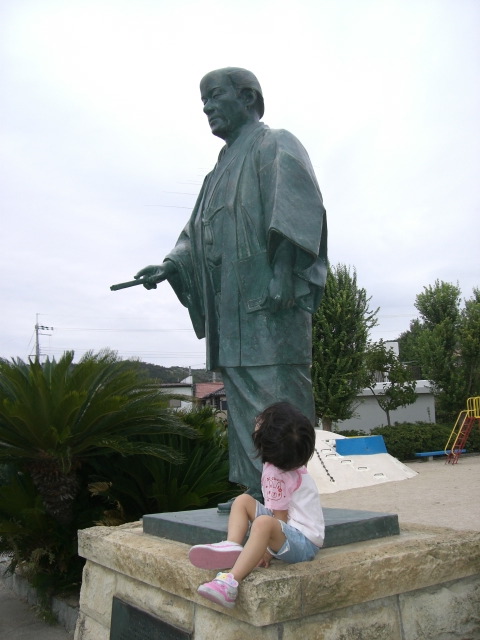
Banto Yamagata (1748 - 1821) is the first Japanese suggested the existence of ETIs.
He said "there are plants, insects, fishes, animals and humans in other planets" in his book "Yumeno-shiro"(1820).
photo: S.Narusawa
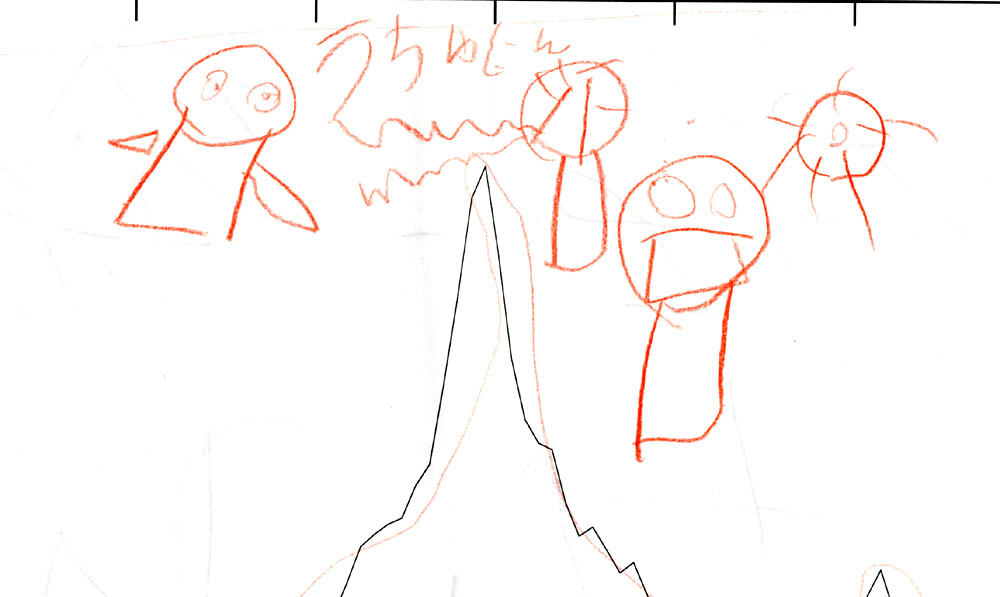
The SETI drawn by my daughter.
left to right, ETI, radio signal, dish antenna, observatory and the Sun.
She knows that astronomers can carry out the radio observation even in the daytime.
|
narusawa (at mark) nhao.jp
Nishi-Harima Astronomical Observatory, University of Hyogo (in English)
|